Sunday, April 21, 2013

Roberto Matta (November 11, 1911 – November 23, 2002)


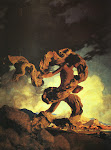
The Earth is a Man

1942

Roberto Matta was a painter who constantly married Surrealism with Abstract Expressionism to quite a high level of success. His works are strange and ethereal, often featuring cloudy emanations of colors. And Dalí seems to have had a strong influence on Matta's paintings, especially in their compositional schemes, which I think is interesting as a reference within the works, but also somewhat damaging, as Dalí is often faulted for the composition of his elements.

It's also interesting to note Roberto's relationship with Arshile Gorky, one of the painters of the twentieth century with the most tragic life. Matta had had an affair with Gorky's wife, who afterwards left Gorky. As Gorky put it, "I made a terrible mistake getting in with these Surrealist people. They're terrible people. The husbands sleep with each other's wives and they're terrible people." Gorky soon after hanged himself, which is something a large part of the Abstract Expressionist movement of the time blamed Matta for. 


X-Space and the Ego

1945


Water

1939


The Day is an Attack

1942


A Grave Situation

1946


Years of Fear

1941

Saturday, April 20, 2013

Otto Dix (December 2, 1891 – July 25, 1969) II


Sylvia von Harden

1927

I decided to do a second post on Otto Dix because of a recent comment on the first. (You can find the first post here.) To begin with, out of all of my posts, the one on Otto Dix has so far been the most popular. Yet the only comment I have received on it is that the work of Dix is not art because it looks demented. While I suppose the person who posted it was a young teen, judging by her skill in writing, the sentiment I think is very common among adults: that is to say, art and clearly perceivable classical beauty go hand-in-hand. To me the question of what defines art has always been rather difficult, and my current theories are a bit too lengthy for a single post, but I want to try to address her comment at least shortly. For me, what I define as art is always beautiful, but it is beautiful by its transformation through the medium and not by the real-world qualities of its parts. That Otto Dix often painted the grotesque does not mean that the painting is just the grotesque mirror of the world, because by many factors, such as subject, symbolism, style, composition and color palette, the objects and ideas are, if you will allow the reference, transubstantiated into something completely new. But I also have to admit that what we accept as art is ultimately subjective. And I can no more successfully argue against a teen's disgust and rejection of Otto Dix than I can of an art critic's rejection of the Avant-garde. 

What do you think?


Grazing Horses

1915


Three Nudes on the Beach

1923 


The Street of Brothels

1914


Prague Street

1920 


Flowers

1923


Portrait of Dr. Fritz Glaser

1921


Prisoners of War

1948


Seated Nude with Blond Hair

1931


David and Saul

1959

Friday, April 19, 2013

Adolphe Joseph Thomas Monticelli (October 14, 1824 – June 29, 1886)


Fishermen Lifting the Nets before the Storm, Coastal Scene

c.1878 

"I think of Monticelli terribly often here. He was a strong man–a little cracked or rather very much so–dreaming of the sun and of love and gaiety, but always harassed by poverty–of an extremely refined taste as a colourist, a thoroughbred man of a rare race, continuing the best traditions of the past. He died at Marseilles in rather sad circumstances, and probably after passing through a regular Gethsemane. Now listen, for myself I am sure that I am continuing his work here, as if I were his son or his brother."


Reverred by van Gogh, adored by the likes of Cézanne, today Monticelli is not only mostly forgotten, but quite often disliked when remembered. For me, his paintings are clearly fantastic combinations of classical themes and a completely novel style. Where does all the dislike arise from?


The Hay Card

c.1882


Sunrise

c.1882-1884


Various Flowers 


Visit to a Princess

c.1860


The Adoration of the Magi

c.1873-1877

Thursday, April 18, 2013

John Constable (June 11, 1776 – March 31, 1837)


Flatford Mill from the Lock

c.1811

Yetserday, in my post on Turner, I mentioned Constable quite a bit, so today I thought I might give you some visual context. To begin with, despite what most people think of him today, Constable was quite unorthodox at times; and it was in those times he was absolutely brilliant, such as in the pre-Impressionistic pieces Flatford Mill from the Lock and Tree Trunks. And though the revolutionary aspects of his works might have been less common and less fantastic than Turner's, it is only because the comparison between the two tends to be forced, owing to their tense history, that the legacy of Constable is small in the world of art today: a sad and unwarranted placing, I think. And I should add, while labeled generally as a Romanticist, he displayed many similarities to Realists, especially to Corot, such as in Malvern Hall and in The Cornfield, below. 


Malvern Hall

1809


Tree Trunks 

c.1821


Stonehenge

1836


The Cornfield

1826 

The painting beneath is from the infamous encounter between Constable and Turner mentioned in the previous post. And, quite frankly, among the oeuvres of both painters, I prefer many other works. Still, it's a very interesting part of art history. 


The Opening of Waterloo Bridge

1817

Wednesday, April 17, 2013

Joseph Mallord William Turner (April 23, 1775 – December 19, 1851)


The Burning of the Houses of Parliament

1834-1835

I had once heard a story that John Constable, a contemporary of Turner's and a Romantic painter, upon visiting a Turner exhibition for the first time, swore he would quit painting from then on, as he could never reach the heights that Turner travelled on. Looking back on this story, I think it's most likely apocraphyl, because I can't seem to locate it anywhere at the moment and Constable and Turner's relationship was far from amicable; at one point, the two had their paintings exhibited side-by-side, in light of which which Turner placed a bright-red stroke on his piece in order to detract from the duller and more common reds of Constable's; Constable famously said soon afterwards, "He has been here, and fired a gun." But, no matter the veracity of the tale, if  any artist in his time could shake the resolve of his contemporaries, it would be Turner. I find it almost impossible to compare him to any of his contemporaries in the least regard. Most of Turner's works bear such strangely wonderful and misty exhalations of colors and such ghostlike compositions that only by stretching forward towards the Impressionists and Tonalists can one begin to feel some sort of similarities. Futhermore, some of his later works move even further in time, towards Abstraction, such as Sunrise with Sea Monsters, just below. 

How can you truly approach describing these paintings?


Sunrise with Sea Monsters

c.1845


 Moonlight, A Study at Millbank

1797


Hafod

c.1799 


Death on a Pale Horse

c. 1825-1830


Stamford, Lincolnshire

c. 1828


Slavers Throwing Overboard the Dead and Dying - Typhon Coming on 

1840


Self-Portrait

c. 1799

Just to add a bit of context to the story, the painting that Constable so despised is now featured below. It unfortunately is not the best version of the piece, but through it I hope you can better imagine Constable's surprise whenTurner, right before the exhibition's opening, stepped beside him and dabbed onto his somewhat somber piece a bright red buoy. 


Helvoetsluys

1832 
     

Monday, April 15, 2013

Are You Still Waiting?


The Fire in the Borgo
1514

To everyone who is still out there and waiting for an update or simply coming to view this site for the first time, hello! 

I had intended to write daily articles when I posted on here last April, but, unfortunately, I soon encountered many unintended obstacles. The foremost, as the picture above hints, was a fire. (I've found that fires are not most terrible in the number of objects they consume, but in the amount of time they consume.) I won't get into the details of it, as I would hate to encumber this blog with a depressing post, but I will discuss a few changes.

One change has been, and I think this is less depressing and more clerical, my financial situation. So, while I'm not dying on the streets, a little extra capital would be nice. That is why I have a new link/image on the right side, furnished by Peter Paul Rubens, which can accept donations into my PayPal account. They are not donations in the tax-deductable sense (I believe they are considered gifts in the US and certain other countries), but I would highly appreciate any amount you would be willing to give, only, of course, if you can truly spare to give. I have also thought about including  one or a couple of advertisements on the site, but I'm not yet sure I'll do so, unless I can make it work well aesthetically.

Ultimately, if you don't care to send any money by PayPal or click on any advertisements, which may never appear anyway, that's perfect for me too, as I'm just glad to be back to sharing art with you. 


Sunday, April 1, 2012

Return! and Claude Monet (November 14, 1840 – December 5, 1926) II

                                                         
Saint-Germain l'Auxerrois
1867

Well, hello there readers. It's been a long while since my last update. And I suppose, for those who may be interested, I should explain my extended posting slumber.

To pick up from my previous post, I had begun a new job and moved within New York City, which took up a significant amount of my free time; but then, just a couple of months later, I moved a second time: to Paris. Now, even to this minute, I'm not completely certain why I made that cross-Atlantic move, but, nevertheless, here I am. And here I've spent all this time becoming acclimated to my new home. 

Having achieved some level of comfort in France, I want to attempt to reanimate this site, though I can't promise that it will be very daily in the next, few weeks, as the engine of my habitude has to warm up. 

So, introductions aside, let's late-start this year with my favorite French painter, Claude Monet. 

A Corner of the Apartment
1875

At the Parc Monceau
1878

Bed of Chrysanthemums
1897

The Bodmer Oak, Fontainebleau Forest
1865

Self-Portrait
1917