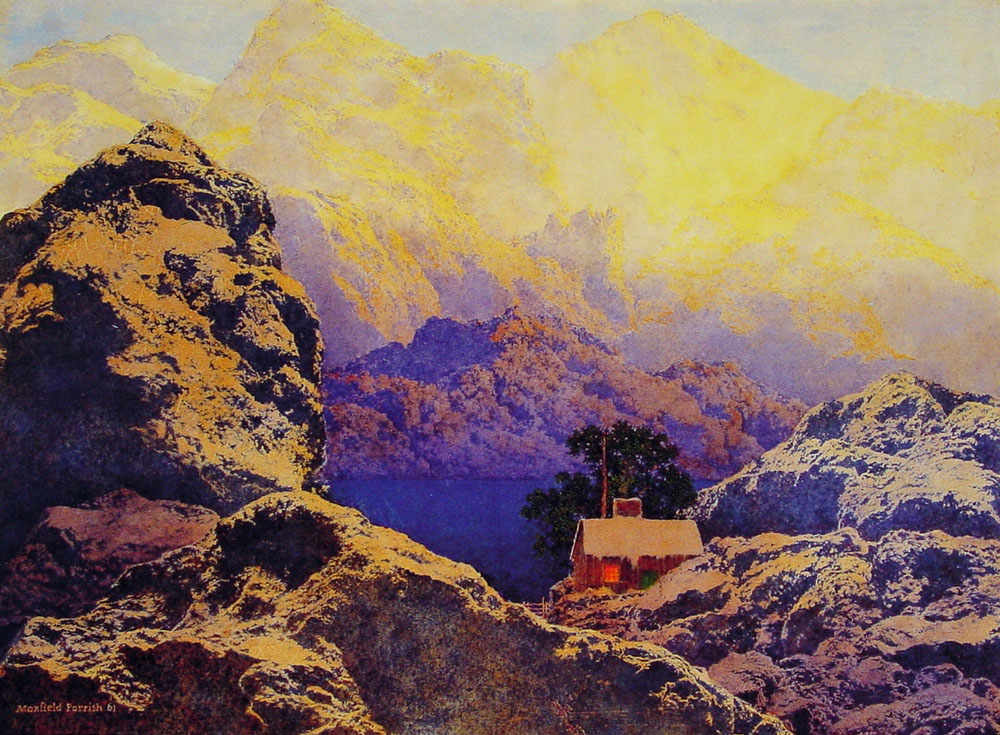
Getting Away from It All
1961
I was thinking of aging and art, today. And it seems that talent rarely perseveres into old age, but rather falls apart. Yet even if the technique of a brilliant mind survives into the latter years, there can't be a significant revolution in the art anymore, though perhaps there can be revelation; I suppose the last point depends on whether you're a Platonist or believe the soul ages. Of course there are exceptions to all that I've said, but most likely not dramatic ones. All of this thinking brought me to Parrish, who lived into his 96th year and who painted into his 91st. At the head of the post I've included his final work, and below this paragraph I've embedded a number of works that he made from his 80th to his 90th year. (Many of these paintings have multiple titles, but the first is always Parrish's own). I've already posted his earlier pieces here, which I think are a great point for comparison. To me, Parrish's last works seem to be far softer in character than his earlier pieces, reflecting, in my mind, a man mostly looking out to nature for beauty than within his own creativity. And that final piece, Getting Away from It All, seems so bittersweet in its obvious message. What do you think of all of this? Am I very wrong?

Peace of Evening or Evening Shadows
1950

Misty Morn or Swift-water
1953

Little Stone House
1954

A Nice Place to Be or Sheltering Oaks or River Bank
1956
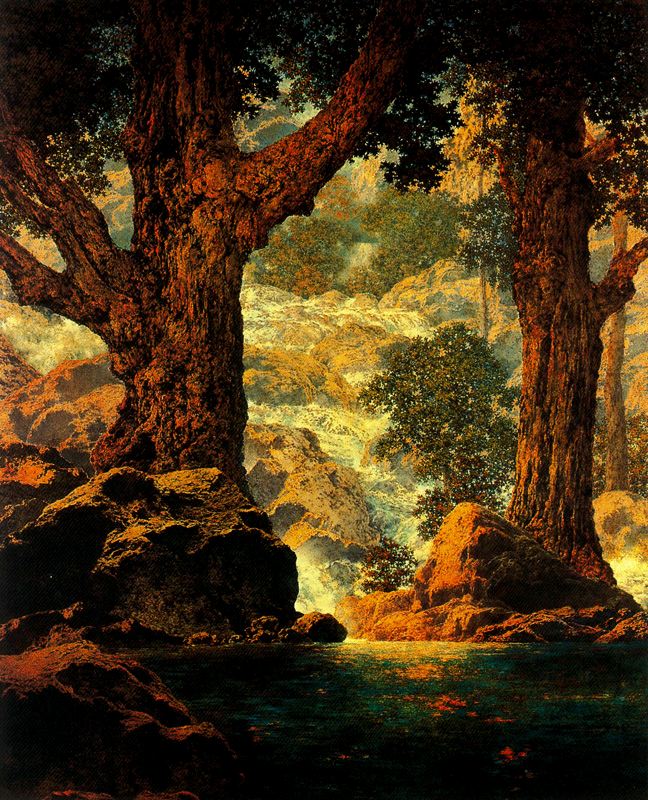
Cascades or Quiet Solitude
1960


 Posts
Posts