Showing posts with label Romanticism. Show all posts

Wednesday, May 1, 2013

Johan Barthold Jongkind (June 3, 1819 – February 9, 1891)


Moonlight over a Canal, Dordrecht

1876

Monet said of Jongkind, "I owe the final education of my eye to him." No faint praise. Jongkind was an amazing artist, who expressed a constant softness in his art, which travelled from Romanticism into Impressionism, and enamored many Impressionists in the earliest days of that style to him for that softness. But there is also a considerable amount of tragedy in his works  I can't quite put my finger on it, and if you know better how to explain it, please leave your version in the comments, but there is a constant melancholy, in the calm darkness and sunlight. This is not too surprising, though, as in his life, Jongkind was very unhappy and only briefly successful. 

Perhaps the tragic quality is a calm too calm.


Skaters in Holland

1863


Near Dordrecht

1870


Boatman by a Windmill at Sundown

1859


The Interior of the Port at Rotterdam, Effect of Moonlight

1875

Monday, April 29, 2013

Fernand Pelez (January 18, 1843 – August 7, 1913)


The Little Lemon Merchant

c. 1895

Pelez is a very interesting, though not particularly well-known artist, who remains unknown, I think, not because he was unoriginal or demonstrated poor execution in his works, but because his novelty was very nebulous. While a French Realist, he shared far more in common, once we look forward, with American Realists, who were greatly interested in social criticism, than with his contemporaries. At other points, Pelez's art takes on strong aspects of Romanticism, as in Adam and Eve, and even foreshadows Photorealism, as in Misery at the Opera. Hard to define, don't you think?


Grimaces and Misery or Circus Performers

1888


Adam and Eve

1876


Misery at the Opera

c. 1885


A Martyr or The Violette Merchant

c. 1885

Thursday, April 18, 2013

John Constable (June 11, 1776 – March 31, 1837)


Flatford Mill from the Lock

c.1811

Yetserday, in my post on Turner, I mentioned Constable quite a bit, so today I thought I might give you some visual context. To begin with, despite what most people think of him today, Constable was quite unorthodox at times; and it was in those times he was absolutely brilliant, such as in the pre-Impressionistic pieces Flatford Mill from the Lock and Tree Trunks. And though the revolutionary aspects of his works might have been less common and less fantastic than Turner's, it is only because the comparison between the two tends to be forced, owing to their tense history, that the legacy of Constable is small in the world of art today: a sad and unwarranted placing, I think. And I should add, while labeled generally as a Romanticist, he displayed many similarities to Realists, especially to Corot, such as in Malvern Hall and in The Cornfield, below. 


Malvern Hall

1809


Tree Trunks 

c.1821


Stonehenge

1836


The Cornfield

1826 

The painting beneath is from the infamous encounter between Constable and Turner mentioned in the previous post. And, quite frankly, among the oeuvres of both painters, I prefer many other works. Still, it's a very interesting part of art history. 


The Opening of Waterloo Bridge

1817

Wednesday, April 17, 2013

Joseph Mallord William Turner (April 23, 1775 – December 19, 1851)


The Burning of the Houses of Parliament

1834-1835

I had once heard a story that John Constable, a contemporary of Turner's and a Romantic painter, upon visiting a Turner exhibition for the first time, swore he would quit painting from then on, as he could never reach the heights that Turner travelled on. Looking back on this story, I think it's most likely apocraphyl, because I can't seem to locate it anywhere at the moment and Constable and Turner's relationship was far from amicable; at one point, the two had their paintings exhibited side-by-side, in light of which which Turner placed a bright-red stroke on his piece in order to detract from the duller and more common reds of Constable's; Constable famously said soon afterwards, "He has been here, and fired a gun." But, no matter the veracity of the tale, if  any artist in his time could shake the resolve of his contemporaries, it would be Turner. I find it almost impossible to compare him to any of his contemporaries in the least regard. Most of Turner's works bear such strangely wonderful and misty exhalations of colors and such ghostlike compositions that only by stretching forward towards the Impressionists and Tonalists can one begin to feel some sort of similarities. Futhermore, some of his later works move even further in time, towards Abstraction, such as Sunrise with Sea Monsters, just below. 

How can you truly approach describing these paintings?


Sunrise with Sea Monsters

c.1845


 Moonlight, A Study at Millbank

1797


Hafod

c.1799 


Death on a Pale Horse

c. 1825-1830


Stamford, Lincolnshire

c. 1828


Slavers Throwing Overboard the Dead and Dying - Typhon Coming on 

1840


Self-Portrait

c. 1799

Just to add a bit of context to the story, the painting that Constable so despised is now featured below. It unfortunately is not the best version of the piece, but through it I hope you can better imagine Constable's surprise whenTurner, right before the exhibition's opening, stepped beside him and dabbed onto his somewhat somber piece a bright red buoy. 


Helvoetsluys

1832 
     

Monday, May 16, 2011

Paul Delaroche (July 17, 1797 – November 4, 1856)

                                                                                                                 
Young Christian Martyr
1855

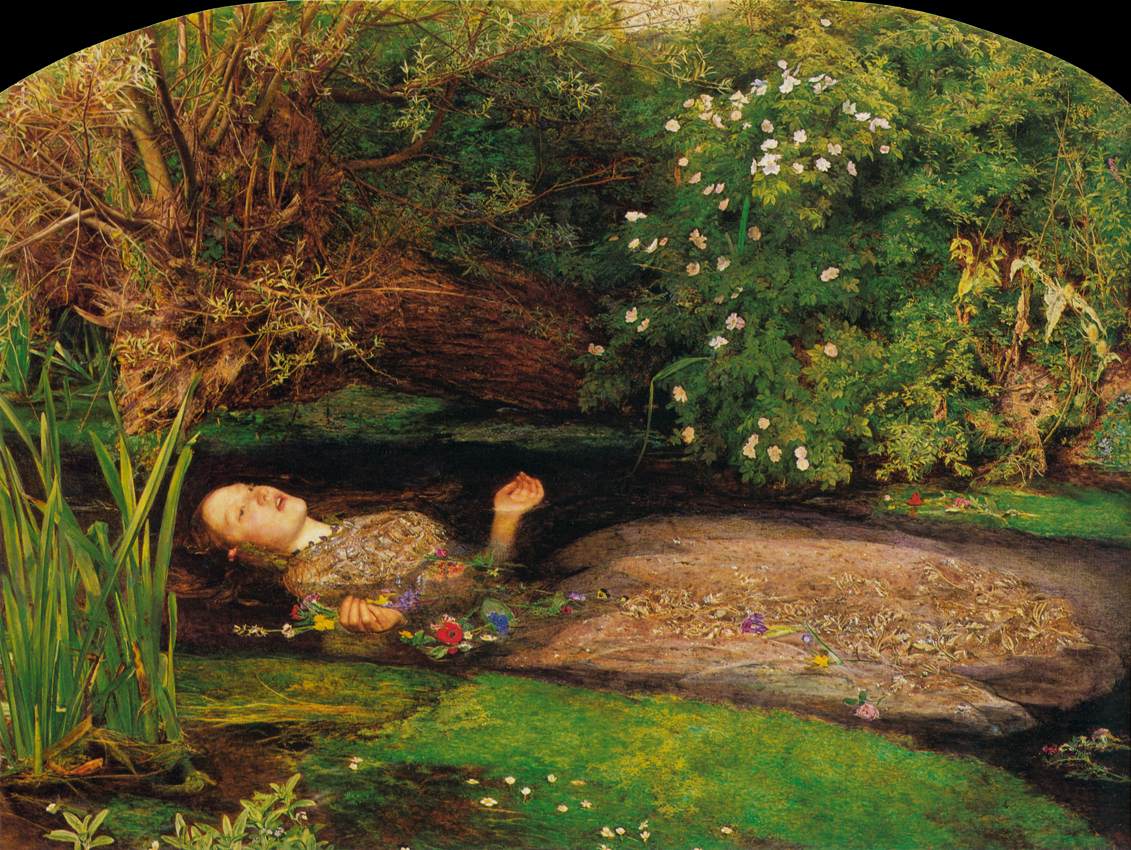
Paul (or Hippolyte) Delaroche was one of the more respected Academic Painters, who, as I've expressed before, are an unfairly maligned group; and it was his Romanticism which led to his greater acclaim. It's not surprising that there are strong, often overwhelming, Romantic elements in his paintings, as he closely associated with Romantic painters, such as Delacroix. There is something very soft about many of his works, a particular blending of idealism with realist details, that I find very appealing; to point, his piece, Young Christian Martyr, when compared to the similar, in period and concept, Ophelia of the Pre-Raphaelite Millais, while not as great a technical achievement, has for me a much greater soul. 

Napoleon Crossing the Alps
1850

The Execution of Lady Jane Grey
1834

Marquis de Pastoret
1829

Joan of Arc in Prison
1824

Portrait of Henrietta Sontag
1872

Sunday, May 8, 2011

Henry Fuseli (February 7, 1741 – April 17, 1825)

                                                                                                                       
The Nightmare
1781

Fuseli created one of the most recognizable paintings of the Romanticist movement: the above featured The Nightmare. It's a famous piece, or rather one version of it, that neatly sums up the whole of Romanticism on one canvas. Fuseli, of course, created many memorable works, though none that have reached the level of cultural ubiquity that The Nightmare has (though that could also be said of many great artists' complete portfolios). His influence was vast, affecting such geniuses as Blake. 

Thor, in the boat of Hymir, battering the Midgard Serpent
1790

Lady Macbeth
1784

The Night-Hag Visiting the Lapland Witches
1796

Silence
1799-1801

The Shepherd's Dream
1793 

The Debutante
1807

Thursday, April 14, 2011

Francisco de Goya (30 March 1746 – 16 April 1828)

                                                                                                    
El Tio Paquete
1819-1820

Goya is an absolutely strange artist, presaging a great many later periods (a sort of early visionary in line with El Greco). In his works there is often a great weight, with the observer given little opportunity to rest her eyes and mind as she peruses a piece. And, for some people, Goya's works are too somber in all aspects to elicit devotion, but for me the works are perfectly relentless. Even his early works, such as The Adoration of the Name of the Lord, which are at times considered Rococo (though for the piece below that's quite a stretch), his unnerving symbolism is present, is wonderful. 

The Adoration of the Name of the Lord
1772

Colossus
c. 1810-1827

The Devil's Lamp
1797-1798

Saturn Devouring His Sons
c. 1819-1823

The Repentant St. Peter
c. 1820-1824

Self-Portrait
1815

Monday, March 28, 2011

Caspar David Friedrich (September 5, 1774 – May 7, 1840)

                                                                                          
Monastery Graveyard in the Snow
1817-1819

Friedrich's life was melancholy, isolated and little lauded, yet after his death his influence became monolithic. Besides the amazing technique that he displayed in his works, there is a tremendous thematic power that overwhelms most observers when they stare into them. There is a pervasive loneliness and miniaturization of the human spirit in his works, which he did not mean simply as an expression of his own depression, but as a representation of his love for the spiritual over the material. There are no Romanticists I can think of whose works more clearly establish their consciences and souls than those of Friedrich. 

Eldena Ruin
1825

Two Men Contemplating the Moon
1819-1820

Winter Landscape
1811 

Self-Portrait
1810