Showing posts with label Northern Renaissance. Show all posts

Tuesday, May 31, 2011

Pieter Bruegel the Elder (c. 1525 – September 9, 1569)

                                                                                                                                           
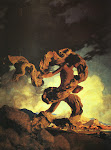
The Fall of the Rebel Angels
1562

I'm back! The lack of updates over the past few days had to do with me running off for Memorial Weekend. I usually try to inform you when I'm going to be taking some time off, but that's not quite been the most accurate system. Oh well! On to the post. 

Bruegel the Elder was a fabulous painter who created a lot of the imagery that surrounds our conception of biblical stories. His The Tower of Babel, see below, is an image that transformed my view of that Genesis tale in my childhood years. As for Bruegel's style, his descent from Bosch is very evident, especially in works, such as the one above, where the swirling of demons and symbols echoes Bosch beautifully. There is also so much, not only in the myriad characters in his works, but also in his beautiful landscapes, which often go unnoticed, but held so much of the soul of his paintings. 

The Hunters in the Snow (January)
1565

The Peasant and the Birdnester
1568

The Tower of Babel
1563

The Parable of the Blind Leading the Blind
1568

Big Fishes Eat Little Fishes
c. 1556

Christ and the Woman taken in Adultery
1565

Tuesday, May 3, 2011

Rogier van der Weyden (1399/1400 – June 18, 1464)

Portrait of a Lady
c. 1455 

Weyden was a tremendous force in the art world during his lifetime. He was so famous that he was even able to eclipse his contemporary van Eyck, an eclipse that has lasted into modern times. (Personally, I don't quite agree with the common assessment, as van Eyck's style always seemed the sharpest and most spiritual out of all the Northern Renaissance painters.) Weyden often imbued a great mystery into his paintings, as in a Portrait of a Lady, which carries obvious parallels in the softness of the character's impression to da Vinci's Mona Lisa. And Weyden is an excellent illustration of the wonderfulness of the Northern Renaissance, which I think has been rather unfairly seen as secondary relative to the advancements of the Italian masters. 

Deposition
c. 1435 
                                                                                                                   
Annunciation Triptych
c. 1440

Portrait of a Woman
c. 1464

Miraflores Altarpiece
c. 1440

Lady Wearing a Gauze Headdress
1435

Bladelin Triptych
1445-1450

Sunday, April 10, 2011

Hans Holbein the Younger (1497 — 1543)

                                                                                            
Portrait of Charles de Solier, Lord of Morette
1534-1535

Holbein is commonly considered one of the greatest portraitists in art history, and that's not a fluff sentiment. As many Northern Renaissance painters, Holbein was able to combine the austerity of the Gothic and Early Renaissance styles with the revolutions of the High Renaissance and Mannerism. Holbein was particularly able at capturing a tremendous amount of life in his characters, especially in their facial features, despite an overwhelming sense of calm among them. A simply grand artist. 

The Artist's Family
1528

The Passion [Detail]
1524-1525

Portrait of Catherine Howard
1540-1541

The Ambassadors
1533

Darmstadt Madonna
c. 1526-1528

Sunday, February 20, 2011

Albrecht Dürer (May 21, 1471 – April 6, 1528)

                                                                                  
Self-Portrait
1500

I usually try to post a limited number of an artists works (I do this for a lot of reasons, which, if I feel like boring you into a strong sleep, I'll one day enumerate), but I couldn't really help breaking that rule with Dürer. And I don't know why I have. I certainly love Dürer and all of his works, yet even among the group of Northern Renaissance painters, I've never preferred him to van Eyck or Bosch. Perhaps, when I was a child, and fond of drawing (or, if honesty is a virtue, doodling), glimpsing Dürer's amazing drawings and etchings had somehow convinced me of a greater art possible in my pen. 

Christ On The Mount Of Olives
1524

Man in Armor on Horseback
1498

Martyrdom of the Ten Thousand
1508 

Nemesis
1501-1503


The Women's Bath
1496

Portrait of Elsbeth Tucher
1499 

Apollo with the Solar Disc and Diana Trying to Shield Herself from the Rays with Her Uplifted Hand 
1504

Lamentation for Christ
1500-1503 

St. Eustace
1501 

Friday, January 7, 2011

Hieronymus Bosch (c. 1450 – August 9, 1516)

                                                                                      
The Garden of Earthly Delights
1503-1504

As a quick warning, you should not open the above picture on a slow internet connection: it is over 13MBs in size. But, in that enormous bulk lies Bosch's genius, for over a single canvas–or panel as is the case above–thousands of esoteric symbols and fancies abound. To me, Bosch's symbolism even seems to be the visual arts equivalent of Joyce's writing. But the more simple truth is that as a child I used to stare longer into his paintings than into any others, because, try as other painters might, they never quite captured the wild rapture of a child's imagination as did Hieronymus Bosch. 

Christ Crowned with Thorns
1510

Saint John on Patmos
1489

The Temptations of Saint Anthony
c.1500

Thursday, December 30, 2010

Jan van Eyck (c. 1395 – July 9, 1441)

                                                                                        
The Arnolfini Portrait
1434

Considered one of the leading painters of the 15th century, Jan van Eyck was and remains extremely appreciated. Personally, he's one of my favorite painters, because of, not only the amazing detail of his pieces, but the eerie, cool realism all of his characters evince. 

The Ghent Altarpiece: Virgin Mary
1432

The Ghent Altarpiece: Adam
1425-1429

The Ghent Altarpiece: Eve
1425-1429


The Ghent Altarpiece: God Almighty
1426-1427