Thursday, April 14, 2011

Francisco de Goya (30 March 1746 – 16 April 1828)

                                                                                                    
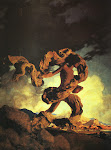
El Tio Paquete
1819-1820

Goya is an absolutely strange artist, presaging a great many later periods (a sort of early visionary in line with El Greco). In his works there is often a great weight, with the observer given little opportunity to rest her eyes and mind as she peruses a piece. And, for some people, Goya's works are too somber in all aspects to elicit devotion, but for me the works are perfectly relentless. Even his early works, such as The Adoration of the Name of the Lord, which are at times considered Rococo (though for the piece below that's quite a stretch), his unnerving symbolism is present, is wonderful. 

The Adoration of the Name of the Lord
1772

Colossus
c. 1810-1827

The Devil's Lamp
1797-1798

Saturn Devouring His Sons
c. 1819-1823

The Repentant St. Peter
c. 1820-1824

Self-Portrait
1815

Wednesday, April 13, 2011

Édouard Vuillard (November 11, 1868 – June 21, 1940)

                                                                                    
Claude Bernheim de Villers
1906

Vuillard was a great artist, whose a tiny bit obscure, but still very well respected. He is known best as a member of Les Nabis, something he was introduced to by Bonnard. Yet he painted in many sorts of Post-Impressionist styles, often somewhat approaching abstraction and coming extremely close to Expressionism. I've tried to display his variety as best as I could in a single post, and I love almost all of his experiments. 

The Ferryman
1897

Interior with Madame Vuillard
c. 1897

Still-Life with Flowers
1921

Arthur Fontaine
1906

Breakfast at Villerville
1910

Nude on an Orange Rug
1909

The Seamstress
1891

Self-Portrait
1889

Tuesday, April 12, 2011

Charles Sheeler (July 16, 1883 – May 7, 1965)

                                                                                          
American Landscape
1930

The Precisionism of Sheeler often, as can be seen in some of these pieces, closely approached Photorealism. But that quality in Sheeler's work was not so much a precursor to Photorealism, as one of the natural evolutions of Futurism, which simply had set aside some of the more Cubist elements of that movement, while it still kept close to the love of angular subjects. Sheeler was certainly a very interesting artist. 

Church Street
1920

Windows
1952

Classic Landscape
1931

Suspended Power
1939

View of New York
1931

River Rouge Plant
1932

Monday, April 11, 2011

Guy Pène du Bois (January 4, 1884 – July 18, 1958)

                                                                                                        
Opera Box
1926

I often talk about artists that are generally neglected, but Bois is a particularly egregious case of neglect in today's art circles. In his lifetime, Bois was a well-known painter and art critic, who championed the Ashcan School of art, which had produced him and contributed to his early style, as well as other prominent artists, many themselves somehow evolved from that wonderful Ashcan style, such as Bois's dear friend Hopper. Furthermore, Bois was to some extent a wonderful culmination of many important artists in the American pantheon, such as Robert Henri and Childe Hassam; and, beyond being a  simple summation, his art also took on many novel aspects. But where is Bois? Bois is forgotten. 

The Reception
c.  1916

Woman Playing Accordion
1924

Dining Out
1919

Singer with Fan
1912

Waiting for the Train
1917

Sunday, April 10, 2011

Hans Holbein the Younger (1497 — 1543)

                                                                                            
Portrait of Charles de Solier, Lord of Morette
1534-1535

Holbein is commonly considered one of the greatest portraitists in art history, and that's not a fluff sentiment. As many Northern Renaissance painters, Holbein was able to combine the austerity of the Gothic and Early Renaissance styles with the revolutions of the High Renaissance and Mannerism. Holbein was particularly able at capturing a tremendous amount of life in his characters, especially in their facial features, despite an overwhelming sense of calm among them. A simply grand artist. 

The Artist's Family
1528

The Passion [Detail]
1524-1525

Portrait of Catherine Howard
1540-1541

The Ambassadors
1533

Darmstadt Madonna
c. 1526-1528

Saturday, April 9, 2011

George Frederic Watts (February 23, 1817 – July 1, 1904)

                                                                                                    
Choosing
1864

Watts is a great artist who doesn't quite fit into any single group in the 19th century. Certainly his art was often very much in the style of the Pre-Raphaelites, influenced strongly by Rossetti. Yet many of his pieces displayed a strong–ultimately dominating–character of Symbolism. It is in fact as a Symbolist that he had the greatest impact, being one of the first artists to experiment in that mode. Just look at The Minotaur, and see how much longing and realism is put into a beast that has almost constantly been displayed as a sinewy monster. What strange and great art. 

The Dweller in the Innermost
1885-1886

The Infancy of Zeus
1896

Hope
1885-1886

Endymion
c. 1870 

The Minotaur
1877-1886

Friday, April 8, 2011

Maurice De Vlaminck (April 4, 1876 – October 11, 1958

The Circus
1906

One of the most important Fauvists, Vlaminick was extremely unique and experimental, though he occasionally wore his influences on his sleeve. To that last point, it's not surprising that van Gogh had a major impact on the artist; Vlaminick went so far as to say, on first seeing van Gogh, "I was so moved, I wanted to cry with joy and despair. On that day I loved van Gogh more than my own father." And, while I love his bright and lively Fauvist pieces, I adore his gloomier works, which seem everlastingly foreboding.

Landscape with Red Roofs
1907

The Bar
1900

Restaurant at Marly-le-Roi
1905

Poplars
c. 1908

Flowers (Symphony in Colors)
1907