Tuesday, March 22, 2011

Remedios Varo (December 16, 1908 - October 8, 1963)

                                                                                                      
The Flight
1961

Varo is one of my favorite Surrealists. Her strange romantic works seems to me to be some form of mature childhood romanticism, if that sort of mildly contradicting sentiment makes sense. My love of her art comes partially from that strong influence of Bosch on most of her paintings (and I am a Bosch fanatic). But another strong portion of my love of her works' comes from that outlandish romanticism that I tried to define earlier, and that makes me gaze into these paintings endlessly.


Harmony
1956

The Cat Fern
1957

Valley of the Moon
1950

Premonition
1953

To Women's Happiness
1956

Monday, March 21, 2011

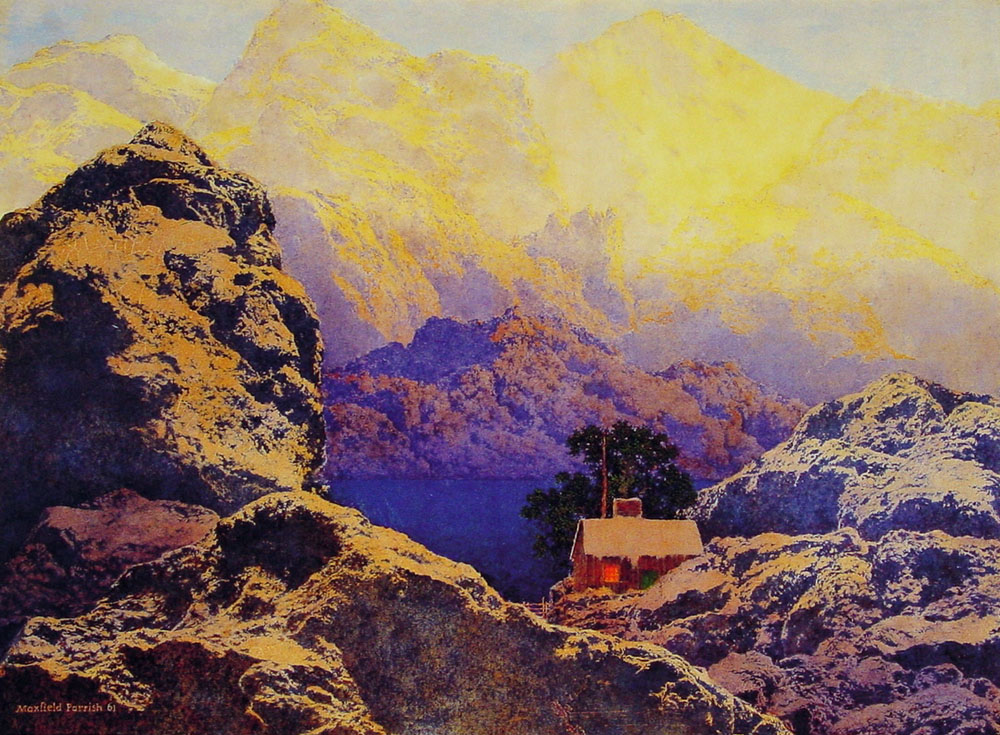
Maxfield Parrish (July 25, 1870 – March 30, 1966) II

                                                                                                      
Getting Away from It All
1961

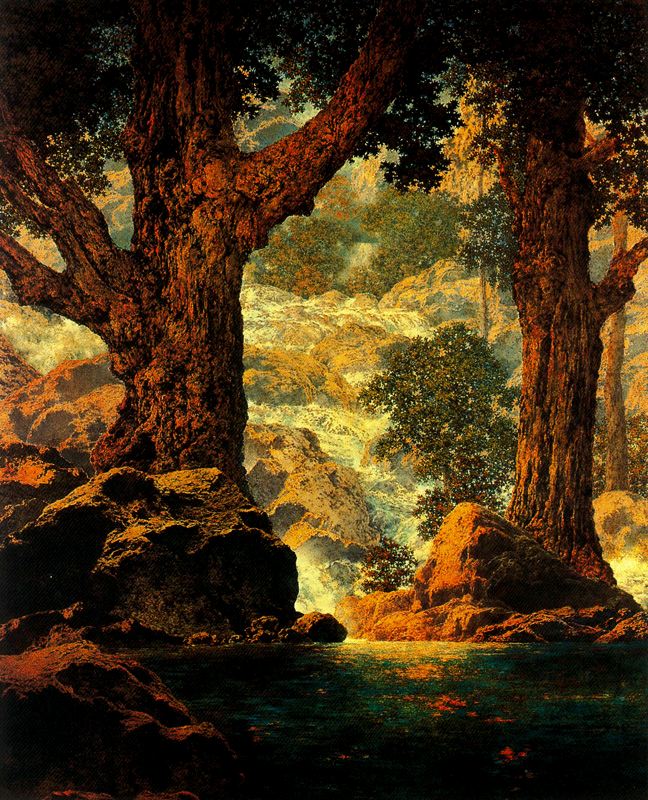
I was thinking of aging and art, today. And it seems that talent rarely perseveres into old age, but rather falls apart. Yet even if the technique of a brilliant mind survives into the latter years, there can't be a significant revolution in the art anymore, though perhaps there can be revelation; I suppose the last point depends on whether you're a Platonist or believe the soul ages. Of course there are exceptions to all that I've said, but most likely not dramatic ones. All of this thinking brought me to Parrish, who lived into his 96th year and who painted into his 91st. At the head of the post I've included his final work, and below this paragraph I've embedded a number of works that he made from his 80th to his 90th year. (Many of these paintings have multiple titles, but the first is always Parrish's own). I've already posted his earlier pieces here, which I think are a great point for comparison.  To me, Parrish's last works seem to be far softer in character than his earlier pieces, reflecting, in my mind, a man mostly looking out to nature for beauty than within his own creativity. And that final piece, Getting Away from It All, seems so bittersweet in its obvious message. What do you think of all of this? Am I very wrong?

Peace of Evening or Evening Shadows
1950

Misty Morn or Swift-water 
1953

Little Stone House
1954 

A Nice Place to Be or Sheltering Oaks  or River Bank
1956

Cascades or Quiet Solitude
1960

Sunday, March 20, 2011

Théophile Steinlen (November 10, 1859 – December 13, 1923)

                                                                          
Gaudeamus
1890

Steinlen is one of the great Art Nouveau artists, who is especially well-known for his strange depictions of cats, often full of supernatural energy. Still, a great portion of his art fell well outside the range of Art Nouveau, such as his wonderful Post-Impressionist pieces, which seem to have been inspired by Gauguin and Cézanne, and Expressionist works, which were perhaps inspired by Realists such as Millet. And yet, it's those cats which hold my interest to Steinlen and seem to best illustrate his originality. 

Massaida on the Divan
1912

Cats
1910

The Kiss

The Coal Sorters
1905

Saturday, March 19, 2011

Oskar Kokoschka (March 1, 1886 – February 22, 1980)

                                                                                        
Dresden Neustadt VII
1922

It finally happened: I missed a post! 110 days of consecutivity, I'm afraid, were all that I could muster. Oh well! We'll just have to restart the count on Daily Artist. Anyway, for this post I've brought you Kokoschka, an extremely talented Austrian Expressionist. Many of his paintings have that rough, offal quality common in German Expressionism, yet some of them have a softness–descended from artists such as Gauguin and Monet–that I adore.   

Two Nudes (Lovers)
1910

Félix Albrecht Harta
1909

London, Panoramic of the Thames I
1926

The Slave Girl
1921

Lovers with Cat
1917

Thursday, March 17, 2011

François Boucher (September 29, 1703 – May 30, 1770)

                                                                                                  
The Rape of Europa
1732-1734

Boucher was one of the leading artists in the Rococo movement. He was strongly, and I think at points very obviously, influenced by Rubens, yet always retained his own, extremely romantic Rococo character. One thing I can say about his art is that it was extremely reflective, in all situations, of a great calm. And Boucher never did strive towards any sort of realism, even saying of nature that it is "too green and badly lit;" is it?

Landscape Near Beauvais
1740

Allegory of Painting
1765

The Rest on the Flight into Egypt
1737

Mercury Confiding the Infant Bacchus to the Nymphs
1732-1734

Wednesday, March 16, 2011

Albert Marquet (March 27, 1875 – June 14, 1947)

                                                                                          
The Blonde Woman

Marquet is sometimes known, rather condescendingly, as a "minor painter." I cannot for the life of me figure out why that is. He painted some of my absolutely favorite nudes, such as the first and last paintings in this post. And, instead of the sort of harshness that a lot of Fauvists were known for, he took a very gentle touch to his paintings that I think wonderfully compliments them. "Minor painter" ... I just don't understand it. 

The Port of Algiers with Haze

Assouan, Morning

Fruit, Knife and Napkin
c. 1898

Nude on a Blue Background
1913

Tuesday, March 15, 2011

Sir Lawrence Alma-Tadema (January 8, 1836 – June 25, 1912)

                                                                                                
The Roses of Heliogabalus
1888

It's interesting the sort of experience Alma-Tadema's reputation has gone through. During most of his life, he was one of the most highly-paid and highly-regarded artists about. Yet, in the last part of his life, his works became anathema to the art world, to the extent that he was almost completely forgotten after his death, until a recent reevaluation in the 1960's. Though it should also be noted that extremely famous film directors often turned to his depictions for inspiration, despite his then-current unpopularity, such as D.W. Griffith and Cecil B. DeMille. But I can't see much of an argument for unpopularity unless you were to say theme, and that's such a terribly subjective point from which to argue. And one last thing, though I've never read this, I do think that he had a strong influence on the absolutely amazing Maxfield Parrish. 

Among the Ruins
1902-1904

A Pyrrhic Dance
1869

A Coign of Vantage
1895

I'd also like to make a quick note about the piece below. While most views of Alma-Tadema were as someone pushing against the various developing movements, notably Post-Impressionism, Fauvism, Futurism and Cubism, he still experimented masterfully with Impressionism, as in the painting Bluebells. 

Bluebells